
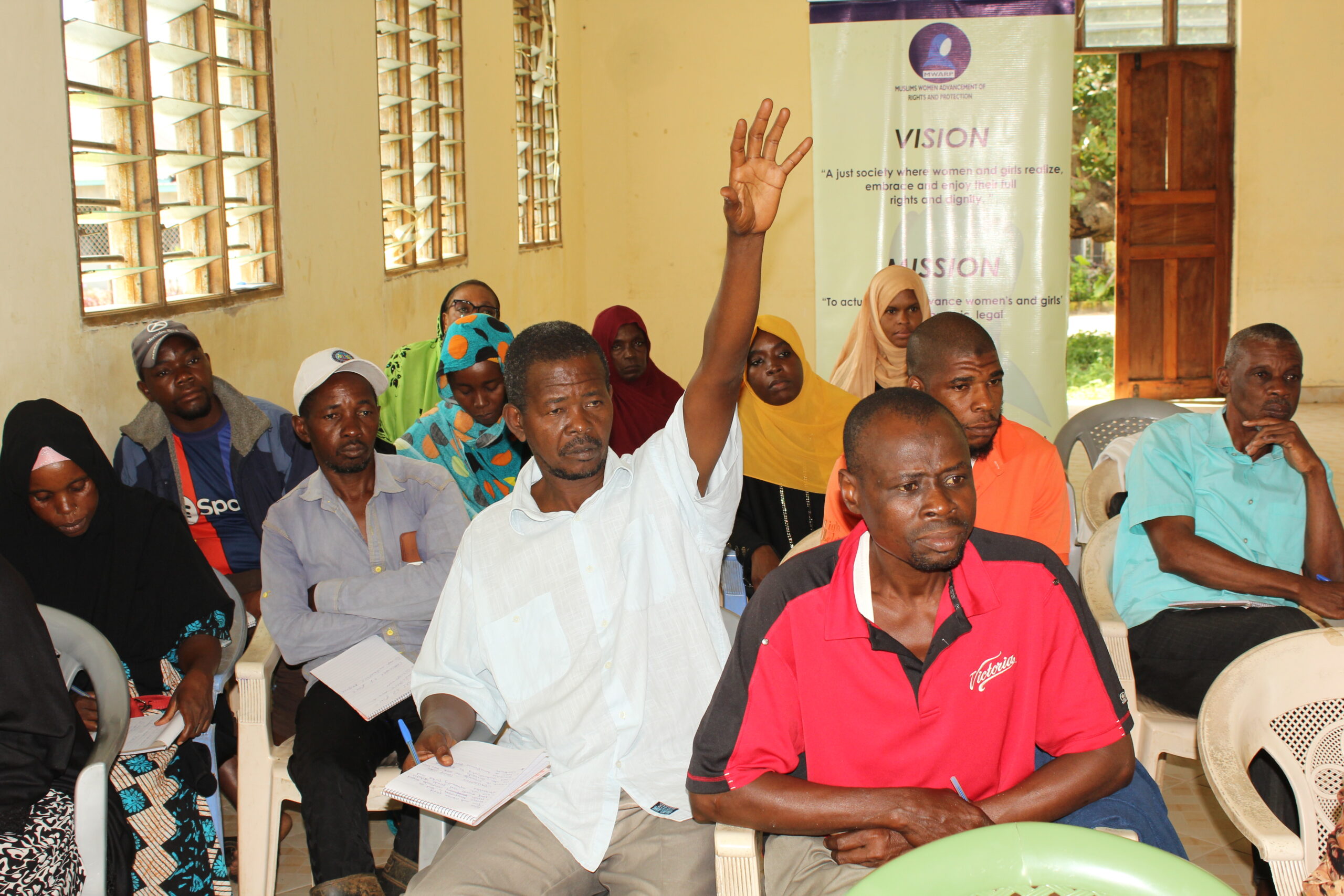
 A section of residents attend project management committee training session at Kanana social hall in Lunga-Lunga sub-county, Kwale County on Thursday, July 24, 2025.[/caption]
He further noted that the initiative not only strengthens the capacity of PMC members but also brings together various stakeholders to foster mutual understanding and coordination in project delivery.
Participants included community leaders, government officials, and representatives from civil society organizations.
One of the participants, Issa Sarai Lunga-Lunga Sub-county lauded the training and said it opened her eyes to key aspects of monitoring, such as reading project bills of quantities (BoQs), understanding timelines, and identifying shoddy workmanship.
“Now I know how to follow up on a project from start to finish,” she said.
Another committee member, Mwanasiti Bakari expressed their satisfaction with the training, saying it had equipped them with new knowledge on how to question, monitor, and report on the actual status of development projects being implemented.
She admitted that before the training, they did not fully understand their roles in project management and often left the responsibility entirely to contractors and government officials.
Bakari said with the new skills, they now feel confident to ask critical questions, demand documentation, and ensure timelines and standards are met.
A section of residents attend project management committee training session at Kanana social hall in Lunga-Lunga sub-county, Kwale County on Thursday, July 24, 2025.[/caption]
He further noted that the initiative not only strengthens the capacity of PMC members but also brings together various stakeholders to foster mutual understanding and coordination in project delivery.
Participants included community leaders, government officials, and representatives from civil society organizations.
One of the participants, Issa Sarai Lunga-Lunga Sub-county lauded the training and said it opened her eyes to key aspects of monitoring, such as reading project bills of quantities (BoQs), understanding timelines, and identifying shoddy workmanship.
“Now I know how to follow up on a project from start to finish,” she said.
Another committee member, Mwanasiti Bakari expressed their satisfaction with the training, saying it had equipped them with new knowledge on how to question, monitor, and report on the actual status of development projects being implemented.
She admitted that before the training, they did not fully understand their roles in project management and often left the responsibility entirely to contractors and government officials.
Bakari said with the new skills, they now feel confident to ask critical questions, demand documentation, and ensure timelines and standards are met.
Kwale grassroots committees trained to hold project implementers accountable
BY SHABAN OMAR Project Management Committees (PMCs) from grassroots areas in Kwale County have received special training on how to assess the quality of development project implementation within their communities. The training was organized

BY SHABAN OMAR
Project Management Committees (PMCs) from grassroots areas in Kwale County have received special training on how to assess the quality of development project implementation within their communities.
The training was organized with the aim of empowering committee members to monitor, evaluate, and ensure that projects implemented by the government or development partners adhere to quality standards, provide value for money, and meet the real needs of citizens.
The training was funded and coordinated by the non-governmental organization Muslim Women Advancement of Rights and Protection (MWARP), which emphasized that community participation in project oversight is a key pillar of accountability and sustainable development.
Speaking during the closing of the training, MWARP’s Kwale County Coordinator, Mwalimu Ali, said that PMCs are critical instruments in ensuring that development projects are not just written on paper but are executed for the benefit of the intended recipients.
He noted that without proper oversight and community involvement, many projects risk being poorly implemented or completely abandoned.
"We have seen cases where projects are launched with great promise but later stall or are completed with substandard materials. That is why empowering local watchdog structures like PMCs is a game changer,” he said.
Mwalimu Ali said that when citizens are equipped with the right skills, they are better positioned to question irregularities, demand accountability, and protect public resources.
He said the training included practical sessions on how to conduct site visits, assess the progress of work, and document findings to relevant authorities.
“The role of PMC members does not end at project approval. They must follow through each phase from planning and procurement to implementation and completion to ensure no shortcuts are taken,” he added.
However, Ali expressed his concern that for a long time, the committees have lacked specialized training on project management, a gap that has often contributed to substandard development outcomes.
He added that the training was timely since it is empowering citizens to take part in holding service providers accountable.
Ali said the communities now understand that they have the right to question the quality of roads, classrooms, water projects, or health centers implemented in their areas.
He also urged other development partners and county agencies to support similar initiatives, noting that community-led oversight can significantly reduce cases of corruption and negligence in service delivery.
According to Ali, strengthening PMCs contributes to transparency and builds trust between citizens and duty bearers.
Furthermore, he called on the trained PMC members to act as ambassadors of accountability within their communities by sharing the knowledge and skills gained with others.
"This training should not end with you. Go out, sensitize your neighbors, and be the eyes and ears of your villages,” he said.
[caption id="attachment_10896" align="aligncenter" width="300"] A section of residents attend project management committee training session at Kanana social hall in Lunga-Lunga sub-county, Kwale County on Thursday, July 24, 2025.[/caption]
He further noted that the initiative not only strengthens the capacity of PMC members but also brings together various stakeholders to foster mutual understanding and coordination in project delivery.
Participants included community leaders, government officials, and representatives from civil society organizations.
One of the participants, Issa Sarai Lunga-Lunga Sub-county lauded the training and said it opened her eyes to key aspects of monitoring, such as reading project bills of quantities (BoQs), understanding timelines, and identifying shoddy workmanship.
“Now I know how to follow up on a project from start to finish,” she said.
Another committee member, Mwanasiti Bakari expressed their satisfaction with the training, saying it had equipped them with new knowledge on how to question, monitor, and report on the actual status of development projects being implemented.
She admitted that before the training, they did not fully understand their roles in project management and often left the responsibility entirely to contractors and government officials.
Bakari said with the new skills, they now feel confident to ask critical questions, demand documentation, and ensure timelines and standards are met.
A section of residents attend project management committee training session at Kanana social hall in Lunga-Lunga sub-county, Kwale County on Thursday, July 24, 2025.[/caption]
He further noted that the initiative not only strengthens the capacity of PMC members but also brings together various stakeholders to foster mutual understanding and coordination in project delivery.
Participants included community leaders, government officials, and representatives from civil society organizations.
One of the participants, Issa Sarai Lunga-Lunga Sub-county lauded the training and said it opened her eyes to key aspects of monitoring, such as reading project bills of quantities (BoQs), understanding timelines, and identifying shoddy workmanship.
“Now I know how to follow up on a project from start to finish,” she said.
Another committee member, Mwanasiti Bakari expressed their satisfaction with the training, saying it had equipped them with new knowledge on how to question, monitor, and report on the actual status of development projects being implemented.
She admitted that before the training, they did not fully understand their roles in project management and often left the responsibility entirely to contractors and government officials.
Bakari said with the new skills, they now feel confident to ask critical questions, demand documentation, and ensure timelines and standards are met.
A section of residents attend project management committee training session at Kanana social hall in Lunga-Lunga sub-county, Kwale County on Thursday, July 24, 2025.[/caption]
He further noted that the initiative not only strengthens the capacity of PMC members but also brings together various stakeholders to foster mutual understanding and coordination in project delivery.
Participants included community leaders, government officials, and representatives from civil society organizations.
One of the participants, Issa Sarai Lunga-Lunga Sub-county lauded the training and said it opened her eyes to key aspects of monitoring, such as reading project bills of quantities (BoQs), understanding timelines, and identifying shoddy workmanship.
“Now I know how to follow up on a project from start to finish,” she said.
Another committee member, Mwanasiti Bakari expressed their satisfaction with the training, saying it had equipped them with new knowledge on how to question, monitor, and report on the actual status of development projects being implemented.
She admitted that before the training, they did not fully understand their roles in project management and often left the responsibility entirely to contractors and government officials.
Bakari said with the new skills, they now feel confident to ask critical questions, demand documentation, and ensure timelines and standards are met.