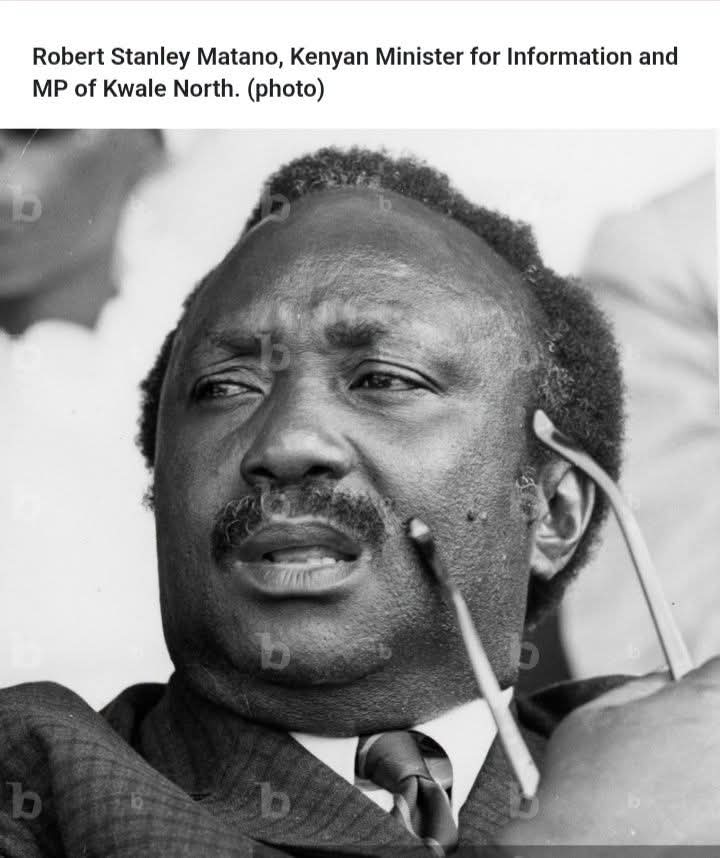
Born in 1925 in Mazeras, Kaloleni, Robert Stanley Matano spent his early childhood tending his father’s livestock and family farm.
Few would have guessed that the disciplined boy from the Coast would one day sit at the very center of Kenya’s independence negotiations and later re-engineer the nation's ruling party into an unstoppable political machine.
Matano began his formal education at Mazeras Intermediate School before moving to the Church Missionary Society School in Kaloleni. A diligent student, he progressed to Kaaga Secondary School in Meru District and subsequently joined the prestigious Alliance High School in Kikuyu in 1941 alongside future political heavyweights Charles Rubia and Nathan Munoko.
In 1946, he proceeded to Makerere College in Uganda, graduating with a diploma in education in 1948.
Returning home, Matano embarked on a distinguished career in education. He began teaching at Ribe Boys Junior Secondary School in 1949 before returning to his alma mater, Alliance High School, as an instructor in 1953.
His administrative acumen soon earned him promotions to education officer roles across Naivasha, Kwale, and Mombasa.
From Classroom to Independence Politics.
In the early 1960s, at the urging of coastal leader Ronald Ngala, Matano resigned from the civil service to enter politics.
Ideologically aligned with federalism, he joined the Kenya African Democratic Union (KADU), which championed a majimbo (regional) system of government in opposition to the Kenya African National Union’s (KANU) preference for a unitary state.
Matano quickly became a key figure in shaping independent Kenya, serving in the delegations to the historic Lancaster House Conferences in London in 1960, 1961, and 1962.
Elected to represent Kinango Constituency in Kwale District a seat he would hold for 27 years, from 1961 to 1988 Matano initially sat on the opposition benches after KANU won the 1963 general election.
However, when KADU voluntarily dissolved in 1964 in the spirit of national unity, Matano crossed the floor alongside his colleagues to join the ruling party.
Within the corridors of power, Matano’s uncompromising integrity often set him apart; peers frequently viewed his strict adherence to principle as political naivety.
Nevertheless, his organizational skills caught the eye of the party leadership.
Between 1966 and 1969, he served as KANU’s Acting Assistant Secretary General. Following the assassination of party Secretary General Tom Mboya in July 1969, President Jomo Kenyatta appointed Matano as Acting Secretary General a post he would hold in an acting capacity for a decade.
Re-engineering a Moribund Party
During the 1970s, Matano presided over a ruling party that existed largely on paper.
As a deliberate political strategy, President Kenyatta and his inner circle avoided party elections, fearing internal contests would deepen national divisions.By the mid-1970s, KANU was practically moribund.
In a candid letter to Kenyatta, National Organising Secretary John Keen lamented that the party had not held a delegates’ conference since 1962 or internal elections since 1964.
Buried under a £20,000 debt, the party had its headquarters' phone lines disconnected for non-payment, and staff went nearly a year without salaries.
In 1975, outspoken Butere MP Martin Shikuku famously declared in Parliament that "KANU is dead." When challenged to substantiate the claim, temporary Speaker Jean-Marie Seroney remarked that there was "no reason to substantiate the obvious"—a comment that resulted in both men being arrested within the precincts of Parliament and detained. Everything changed after Kenyatta’s death in 1978.
Unlike his predecessor, incoming President Daniel arap Moi—himself a former KADU founder—believed in governing through a strong, centralized party apparatus.
In 1979, Moi formally confirmed Matano as KANU Secretary General and tasked him with breathing life back into the organization.
Backed by fresh state financing, Matano oversaw a sweeping overhaul of KANU.
He established a robust secretariat headquartered at the Kenyatta International Conference Centre (KICC) in Nairobi, opened branch and sub-branch offices across every district, and orchestrated grassroots-to-national elections.
Under his stewardship, KANU transformed into a formidable political machine that effectively superseded the civil service in national influence.As the gatekeeper of party clearances in a de facto one-party state, Matano weathered fierce political storms.
The most explosive episode occurred at KICC in 1979 during a heated dispute over clearing former Kenya People’s Union (KPU) members, including Jaramogi Oginga Odinga, to contest parliamentary seats. Tensions boiled over into a physical altercation when KANU National Treasurer Justus ole Tipis lunged at Matano and struck him on the head with his rungu (club).
Fall from Grace and Multiparty Advocacy
Despite his loyalty and central role in consolidating KANU’s power, Matano was not immune to the shifting tides of Moi-era politics.
In 1985, while traveling by train from his Mazeras home to Nairobi, Matano learned via a terse one o’clock radio bulletin from the Presidential Press Unit that he had been dismissed as Minister for Information and Broadcasting.
Three years later, in the infamous 1988 mlolongo (queue-voting) elections a widely criticized system designed to weed out politicians deemed insufficiently loyal to the regime Matano was unseated in Kinango by political newcomer Ali Bidu, ending his 27-year parliamentary run.
Having experienced firsthand how single-party machinery could be weaponized to end political careers, Matano became a vocal proponent of multiparty democracy in the early 1990s.
For him, political pluralism was not merely about restoring freedoms of speech and association, but about fostering institutional tolerance and accommodation. He later joined forces with other coastal leaders, including Chirau Ali Mwakwere, as a founding member of the coastal-based Shirikisho Party of Kenya, though the outfit struggled to gain national traction.
A Complex Legacy
Throughout his long public career, Matano mentored a generation of prominent coastal politicians, including future Cabinet ministers Shariff Nassir and Noah Katana Ngala.
Yet his legacy remains a study in contrasts.Even his detractors acknowledged his rare personal probity.
Former Cabinet minister Suleiman Shakombo described him simply as "a clean man" who eschewed graft, while former civil servants noted that Matano steadfastly refused to use his ministerial clout to secure government jobs for his children or relatives.
On the other hand, critics at the Coast faulted him for failing to translate his immense national influence into tangible local development.
He faced enduring criticism for not championing the rights of the coastal landless or speaking out during the collapse of vital regional industries such as the Ramisi Sugar Company and the Kilifi Cashewnut Factory whose closures devastated thousands of livelihoods in Kwale and Kilifi.
After stepping back from active politics, Matano farmed in Kinango before retiring quietly to his rural village of Ndugu ni Mkono in Mazeras. Having refused to enrich himself in office, he spent his twilight years in modest means, passing away in poverty at a Mombasa hospital in 2008 at the age of 83
Robert Stanley Matano: The Incorruptible Architect Behind KANU’s Revival
Within the corridors of power, Matano’s uncompromising integrity often set him apart; peers frequently viewed his strict adherence to principle as political naivety.